Newfoundland’s forestry industry has long been central to the development of its economy, culture, and communities. The island’s maritime boreal forest was first harvested for fuel, lumber, and boat building. However, the end of the nineteenth century saw the advent of the pulp and paper industry and the granting of expansive timber leases to encourage development. The pulp and paper industry would go on to help establish the company towns of Grand Falls and Corner Brook, whose mills would operate for the next 100 years and beyond. While the industry in Newfoundland is often associated with these two towns, to discover the origins of Newfoundland’s pulp mill industry one must look to the north shore of Placentia Bay. Here, hidden among a grassy field and dense alders, lie the remains of Newfoundland’s first pulp mill.
The mill was built in 1897 by the Newfoundland Chemical Wood Pulp Company Ltd. At the time, the company was owned by Harvey and Company, a St. John’s business with a mandate to attract British investors and paper mill owners to the island and exploit its forestry resources. To demonstrate what the island had to offer, the Newfoundland Chemical Wood Pulp Company Ltd. constructed a “trial” pulp mill at the mouth of Black River, near the community of Swift Current.
The undeveloped site was ideal for the placement of a mill. Its location at the mouth of the Black River meant a dam could be constructed and used as a source of power, while remaining close to the ice-free, deepwater inlet of Placentia Bay for accessible shipping. Construction began in May 1897 and was completed in November of the same year. During this period, approximately 400 workers were employed to build a dam, offices, stores, a manager’s residence, and the mill itself.
The dam redirected water to the river’s east side, where it flowed through two turbines directly connected to the mill’s stone grinders. When it opened, the mill was capable of producing 20 tons of pulp per day. Welcomed by neighbouring communities, the mill provided employment for 40 people, with an additional 200 hired to log the 340 square kilometres of timber limits the company had acquired in the region surrounding the Piper’s Hole River. In February 1898, 2,000 tons of pulp were shipped to Manchester, England, where it was distributed among mill owners and investors across the country. The pulp was soon assessed as meeting required standards, and prospects for the Black River Pulp Mill appeared favourable.

This optimism did not last long, however. While the quality of the pulp appealed to British investors, doubts grew over whether the river could supply sufficient water to maintain year-round production. Further concerns included the mill’s relatively low production capacity and high operating costs. This combination of factors discouraged additional investment, and as a result, the vision of a major logging operation on the Black River came to an end.
In 1903, the Newfoundland Chemical Wood Pulp Company Ltd. shut down the mill. While the operation was revolutionary within the timeline of Newfoundland’s forestry history, it also hindered progress for many years. Investor doubts about the mill’s viability were said to have given the wrong impression of the island’s forestry potential, discouraging others from taking the risk of trying again.
Fortunately for the people of the island, the British-owned Anglo-Newfoundland Development Company (AND Company) was not deterred. It was not long after the closure of the Black River Pulp Mill that the Grand Falls Pulp and Paper Mill began operations. The Grand Falls mill closed in 2009 after more than 100 years of production. Today, the only operating pulp and paper mill on the island is located in Corner Brook.


About the Area
The Black River Pulp Mill and its legacy within Newfoundland’s forestry industry embody the very idea of a hidden wonder. Once a pioneering industrial site, the mill set the stage for future forestry development that would later establish major centres such as Grand Falls and Corner Brook. As individuals who grew up in the latter, it is disheartening to see such an important piece of built heritage largely lost to time.
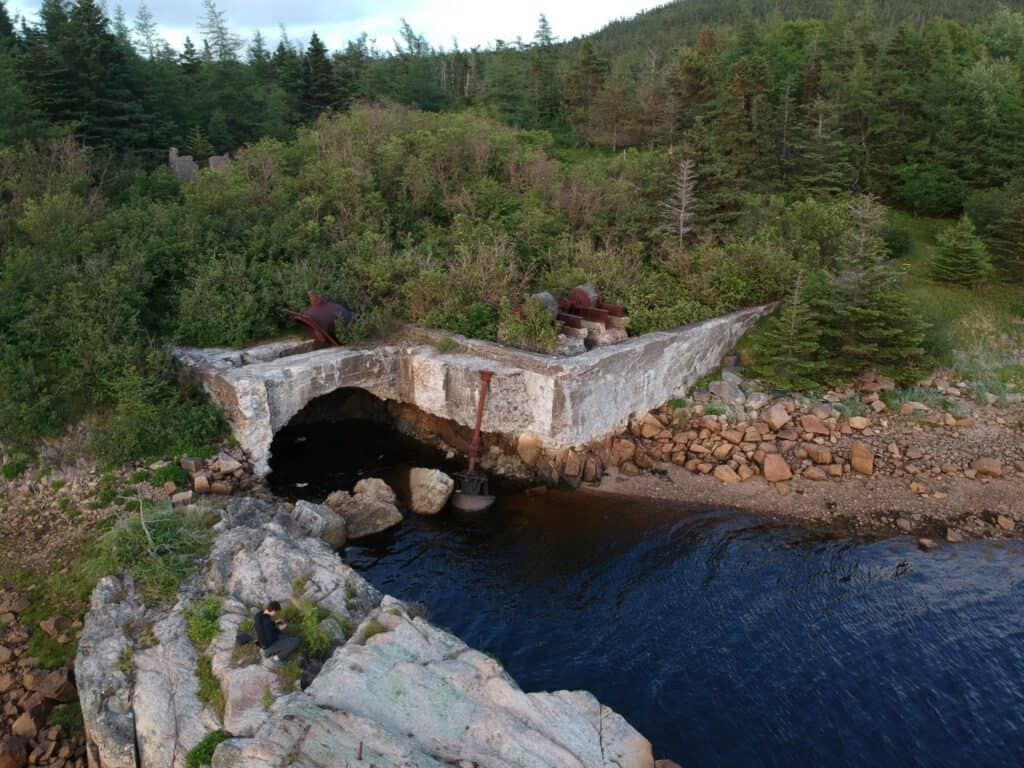
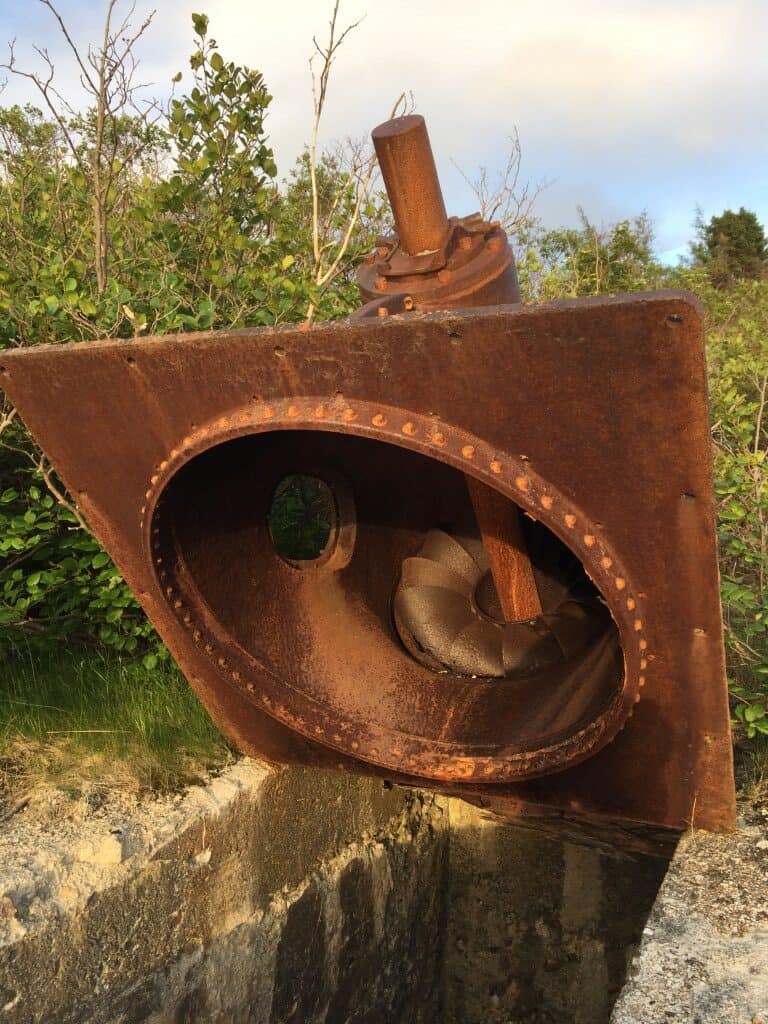
At the site today, portions of the mill’s foundation remain visible along the shoreline. The most prominent surviving section once supported the mill’s short penstock and grinder wheels. The wheels themselves remain intact, still attached to the shaft that once powered the grinders. Closer to the river, remnants of the earthen dam can also be seen, despite the river now flowing freely. Throughout the surrounding area, additional pieces of rusting machinery and concrete structures are scattered among the vegetation.

Sources and Further Reading
McNeily, B. (1998). Black River Pulp Mill. Newfoundland Quarterly, Summer 1998. Available at: http://sites.rootsweb.com/~cannf/pbbrpulp.htm