The waters surrounding the island of Newfoundland have long been known for their unforgiving nature. Notoriously treacherous and unpredictable, dangerous weather and rocky, jagged coast have continually plagued the island. For thousands of years, islander’s have relied on their coastal waters to provide a living whether that be through fishing the Grand Banks or working on the ferries traveling to and from Nova Scotia. Newfoundland’s maritime history is long and complex, and did not come without tragedy. Living proof of this are the many shipwrecks that can be found along it’s vast coast. Of course, most of it’s wrecks have been lost to the ocean, but hidden among it’s many harbours and islands are hundreds dozens of wrecks to discover continuing to withstand the elements.

Many of these vessels have long since been reclaimed by the sea, ground down by the relentless pounding of the North Atlantic surf. Today, they exist as thousands of submerged sites, accessible only to those brave enough to dive or snorkel in Newfoundland’s frigid depths. However, for those who prefer to keep their feet dry, the province also boasts one of the largest collections of surface-level shipwrecks in Canada. These visible remains serve as a haunting testament to a culture whose very survival was inextricably tied to the sea.
From renowned Arctic explorers and heavy cargo ships to the final wooden warships of the British Navy, the diverse array of wrecks along the coast offers a captivating opportunity for exploration. These skeletons of steel and timber represent only a small fraction of the history nestled against our cliffs. Each hull encapsulates a unique narrative, holding within its decks the echoes of the adventures and final moments of those who sailed them.
Visiting these wrecks offers a fascinating journey into the past, allowing explorers to immerse themselves in the compelling stories that unfolded before these relics came to rest on Newfoundland’s rugged shores.

The Famous Arctic Explorer; SS Thetis
Freshwater Bay, St. John’s
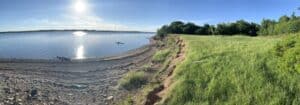
Freshwater Bay, nestled between Fort Amherst and Blackhead along the East Coast Trail, harbors the remnants of the SS Thetis, a famed Arctic explorer ship. Strewn across a picturesque rocky beach at the bay’s far end are the rusted remains of this historic vessel, which played a pivotal role in the 1884 Greely Expedition. Originally built in 1881 as a whaler in Scotland, the Thetis was later acquired by the United States Navy for Arctic rescue missions.


After heroically saving seven survivors of the Proteus disaster in 1884, the Thetis continued its service with the US Navy and US Coast Guard until its decommission in 1916. Subsequently sold to Job Brothers and Company Ltd., the ship was repurposed as a sealing vessel in St. John’s Harbour. In 1950, after a final decommissioning, the Thetis was towed to Freshwater Bay, where it ran aground, deteriorating over time.


Today, the beach at Freshwater Bay is scattered with remnants of the Thetis, including bits of boilers and internal structures. The ship’s figurehead, now housed at the Rooms, stands as a testament to its storied history. Additionally, some debris on the beach is believed to be remnants of the Vasco D’orey, a Portuguese fishing trawler towed into the bay after catching fire in St. John’s Harbour. Accessible through hiking trails from Fort Amherst, Blackhead, or the Cape Spear Highway, Freshwater Bay invites exploration into the fascinating maritime history of Newfoundland. Visit the East Coast Trail website for more information on accessing this historical site.
Sources & Further Exploring
Noble, D. L., & Strobridge, T. R. (1977). The Arctic Adventures of the Thetis. Arctic, 30(1), 1–68. https://doi.org/10.14430/arctic2679.

S.S. Ilex
Kingman’s Cove, Fermeuse Harbour
Resting on the rocky shores of Fermeuse Harbour lies the rusting hull of the S.S. Ilex; a 694-ton vessel owned by Wareham and Sons of Spencers Cove in Placentia Bay. On the morning of October 27, 1948, the Ilex left St. Johns en route to Kingston, Jamaica with a shipment of salt fish when an approaching storm forced the ship to seek refuge in Fermeuse Harbour. By the time night had fallen, the crew had securely tied the ship to a wharf in Kingman’s Cove.


However, shortly after the Ilex was secured for the night, a fire broke out in the engine room caused by the ignition of fuel in the ship’s oil-fired boiler rooms. The Western Star reported that the chief engineer on board at the time, Arch Sutherland was nearly killed by the initial backdraft explosion. Luckily the entire crew was able to escape by lifeboat just before the ship was fully engulfed in flames. After smoldering for several days, the crew managed to salvage what they could of the cargo but the damage to the ship was irreparable and thus the ship was left as it is today.
The ship is not known by many nor has it been turned into a tourist attraction like so many others around the province (ie. SS Charcot or SS Kyle). The easiest place to view the ship is across the harbor on the road to Port Kirwan. But for those wishing to venture closer, a short hike along the rocky beach in Kingman’s Cove will bring you alongside the ship’s remains. While the hike to the ship is well worth the trek, the best way to explore the ship is by kayak or paddleboard.
Sources & Further Exploring
Flynn, D. (2016). The Day the Ilex Burned. The Downhome. Found at www.downhomelife.com/article.php?id=1755.
Western Star (1948, November 5). SS Ilex is Destroyed by Fire at Fermeuse. Western Star (Corner Brook). Retrieved from the Centre for Newfoundland Studies.

Wrecks of the SS Charcot, SS Southern Foam, and SS Sukha
Conception Harbour, Conception Bay
Constructed in 1923 in Tonsberg, Norway, the steel-hulled SS Charcot was originally designed for whaling expeditions in the North Atlantic. After a series of ownership transfers, the ship eventually became part of Captain Johan Borgen’s fleet at the Hawkes Harbour Whaling Company, measuring 117 ft in length and weighing 212 tons.


In 1970, a storm broke the ship’s moorings, causing it to be pushed ashore near Conception Harbour, just 4 km north of Avondale. Initially thought to be the SS Sposa by locals, underwater surveys conducted by the “Shipwreck Preservation Society of Newfoundland and Labrador” revealed it to be the SS Charcot. Further exploration uncovered two additional sunken whaling vessels, identified as the SS Southern Foam and the SS Sukha.
Today, the rusted hull of the SS Charcot emerges from the water onto a beach, accompanied by remnants of old mechanical parts. These maritime artifacts, visible from the CBS Highway (Route 60), offer a glimpse into Newfoundland’s whaling history. A small parking area and picnic spot near the ship’s hull provide easy access for those intrigued by this maritime heritage.
Sources & Further Exploring
Read more about this shipwreck and more by visiting the Newfoundland and Labrador Shipwreck Preservation Society http://www.shipwrecksnl.ca/.

SS Kyle: The Last Of The Newfoundland Coastal Ships
Harbour Grace, Conception Bay
Situated on the west side of Conception Bay, the community of Harbour Grace boasts a rich history, encompassing tales of pirates and aviation. Dominating the landscape as one enters the town is the slightly tilted, weathered steamer ship known as the S.S. Kyle—an enduring symbol for the community.


Built in Newcastle-on-Tyne, England, in 1913 by Swan Hunter & Wigham Richardson Ltd., the S.S. Kyle was part of the Alphabet Ship Fleet commissioned by the Reid Family Company to serve Newfoundland’s coastal communities. Notably, it became the first ship to regularly transport passengers, cargo, medical supplies, and healthcare workers to parts of Labrador.
Originally named after towns in Robert Reid’s Scottish homeland, the Kyle garnered a reputation as the strongest and fastest among the Alphabet Fleet. It weathered ice flows in the North Atlantic and played a crucial role during World War II, transporting Newfoundland military personnel. Eventually sold and renamed the Arctic Eagle, the Kyle continued its service in sealing expeditions before its tragic encounter with an iceberg in 1967.


On February 4th, 1967, strong winds and waves broke the Kyle’s moorings, pushing it ashore in Harbour Grace. Despite inspection, the cost of salvaging the ship was deemed prohibitive. Subsequently, the decision was made to flood the hull, anchoring the ship in its final resting place. Sold to the provincial government in 1972 for $4,000, the S.S. Kyle remains a compelling testament to Newfoundland’s maritime history, captivating visitors with its storied past.
Sources & Further Exploring
Smallwood, J. R., & Pitt, R. D. W. (1981). Encyclopedia of Newfoundland and Labrador. St. John’s, N.L.: Newfoundland Book Publishers. (Articles: “Harbour Grace” & “Kyle, S.S.”. Available online through the Centre for Newfoundland Studies collections database)
SS Kyle. Town of Harbour Grace’s website found at www.hrgrace.ca/tourism-heritage/attractions/ss-kyle/.
Learn more about the SS Kyle by exploring SS Kyle: Newfoundlands 1st Scheduled Ferry Boat website found at www.sskyle.org.

SS Ethie
Gros Morne National Park
In Newfoundland, the SS Kyle isn’t the sole relic from the Alphabet Fleet etched into the coastline. In Gros Morne National Park, amid the communities of Sallys Cove and St. Paul, lie the corroded remnants of the SS Ethie. Originating from Glasgow, Scotland, and crafted by A. & J. Inglis in 1900, the ship was commissioned by the Reid Newfoundland Company for its coastal fleet. Measuring 155 feet in length, 25 feet in width, and 13 feet in depth, the SS Ethie held a gross tonnage of 440 tons.


Functioning much like its Alphabet Fleet counterparts, the Ethie served as a passenger and cargo vessel, catering to Newfoundland’s isolated coastal communities. However, tragedy struck on December 10, 1919, as the ship encountered a fierce storm while en route from Port Saunders to Cow Head. Attempting to run aground near Martin’s Point to save its 92 passengers and crew, the ship unexpectedly hit a shoal, trapping it in treacherous waters.

Despite the perilous situation, the crew executed daring rescue efforts using a pulley system attached to a buoy, ensuring the safety of all on board. While the storm subsided in the following days, attempts to salvage the ship’s cargo were thwarted by relentless surf. Today, rusted pieces of the Ethie’s steel hull, portholes, and boilers can be found along Martin’s Point beach, marking the site of the ship’s tragic demise. Preserving tales of rescue and survival, the location has become a prominent tourist destination on the Viking Trail, attracting hundreds each year eager to unravel the story of the Ethie’s ill-fated journey.
Sources & Further Exploring
Gullage, J. (1950, December). The Wreck of the S. S. Ethie. Atlantic Guardian. http://www.newfoundlandshipwrecks.com/Ethie/Documents/wreck_of_the_s_s_ethie.htm
Smallwood, J. R. (Editor), Pitt, R. D. W. (Editor). (1981). Encyclopedia of Newfoundland and Labrador, volume 1 [Extract: letter E]. St. John’s: Newfoundland Book Publishers (1967) Ltd. Retrieved from https://dai.mun.ca/PDFs/cns_enl/ENLV1E.pdf

The Wreck of the SS Ahern Trader
Frederickton, Near Gander Bay
In the heart of Frederickton lies the remnants of the SS Ahern Trader, a cargo vessel that once plied the route between Newfoundland’s coastal communities and Montreal. Grounded in 1960 by strong winds and ice, the ship now stands as an enduring symbol and a poignant tale of maritime loss in the North Atlantic. While some view it as an eyesore slated for removal, like many shipwrecks in Newfoundland, it has evolved into an icon and a testament to the region’s seafaring history.

Launched in Scotland in 1922, the steel-hulled Ahern Trader, weighing 744 tonnes and measuring 61 meters, initially served as a coastal supply vessel under various names. Acquired by the Ahern Trading Company, it became the SS Ahern Trader. On January 8, 1960, the ship arrived in Frederickton with a hay shipment under the charter of the Canadian National Railway. Facing a storm with 120-130 km/h winds and heavy snowfall, the ship, fearing damage to the wharf, set sail to anchor offshore until the storm subsided.

Amid rough seas and low visibility, the ship attempted to anchor, but the anchor broke, forcing it onto jagged rocks. The crew, unharmed but stranded, signaled for help, and community members rushed to assist. Salvage operations involving tugboats from St. Johns were unsuccessful, costing $70,000. Eventually left stranded, the ship succumbed to rust and storms, toppling over in 2011. Despite varying stories about its arrival and departure, the SS Ahern Trader remains a captivating symbol in Frederickton, drawing tourists keen on capturing the essence of its maritime history.
Sources & Further Exploring
Ahern Trader Shipwreck. Town of Carmenville website found at www.townofcarmanville.ca/index.php?option=com_content&view=article&id=3&Itemid=27.
Daily News (1960, March 05). Will Try to Refloat. The Daily News (St. John’s, NL). Accessed through the Centre for Newfoundland Studies.
Gunn, A. (2011, January 18). Steamship Beached for 51 Years Gets New Angle on Life. The Southern Gazette. Retrieved from www.pressreader.com/canada/the-southern-gazette/20110118/281814280315696.

HMS Calypso: Britain’s Last Wooden Warship
Embree, Indian Bay
Commander Frederick M. Walker of the Newfoundland Royal Naval Reserve commissioned the HMS Calypso in September 1902 as a drill and depot ship in Devonport. Designed for training reservists in naval warfare, the ship played a crucial role in preparing Newfoundland for the defense of the British Empire. Launched on June 7, 1883, the Calypso was a third-class barque cruiser with a displacement of 2770 tons, boasting a range of guns, including twelve 5-inch guns later transferred to Signal Hill.


Permanently docked in St. John’s due to being deemed unseaworthy, the Calypso underwent changes, including its renaming to HMS Briton in February 1916. Post-World War I, the Royal Naval Reserve in Newfoundland disbanded, leading to the sale of the HMS Briton in 1922 for use as a coal and salt storage hulk. In 1952, towed to Lewisporte, it faced uncertainty until 1968 when it was set on fire and sank in a cove in Embree.


Today, the remnants of the HMS Briton lie partially above the waterline, 50 meters from shore, accompanied by the shell of an old fishing trawler. While much of its equipment was removed during its service years, artifacts, including a quick-firing 3-pound Hotchkiss Gun, can be found in the lobby of the HMCS Cabot in St. John’s. The legacy of the HMS Calypso/Briton lives on through the Calypso Foundation of Lewisporte, supporting disabled individuals, and a list of reservists who trained on the ship can be explored on the Admiralty’s House Website. The ship’s technological contributions, such as its large searchlights powered by steam engines, remain noteworthy in maritime history.
Sources & Further Exploring
Decks Awash (1986). History: Lewisporte. Decks Awash, Vol. 15, No. 3, May-June 1986. Retrieved from the Centre for Newfoundland Studies.
Evening Telegram (1902, September 16). H.M.S. Calypso: The Training Ship for St. John’s. Evening Telegram. Retrieved from the Centre for Newfoundland Studies
Evening Telegram (1901, July 8). Newfoundland’s Naval Reserve. Evening Telegram. Accessed through the Centre for Newfoundland Studies
Nicholson, G.W.L., & Facey-Crowther, D.R. (2014). The Fighting Newfoundlander. Montreal, QC: McGill-Queen’s University Press.