
The island of Newfoundland played an important role in the defence of North America during the Second World War. Its strategic location at the edge of the continent, combined with its unique political situation at the time, led to the establishment of three different military forces on the island. Governed by a Commission of Government overseen by the United Kingdom, Newfoundland soon became home to British, Canadian, and American armed forces. One of the largest bases established on the island during the war was located on a large, flat peninsula extending into Placentia Bay, where between 1941 and 1994 the United States operated a Naval Air Station and Army base.

On the peninsula itself, a large airfield, dockyard, seaplane base, and operating facilities were constructed. On the mainland, Fort McAndrew, an army base was built to provide living quarters for personnel working at the base and to offer protection against potential sea and air attacks.
The purpose of Naval Air Station Argentia was to provide defense and resupply support for ships and aircraft travelling with convoys delivering supplies to the war in Europe. Following the war, the station remained active as a submarine and naval supply base during the Cold War. At its peak, approximately 20,000 American servicemen were stationed at the air station, and the services it provided helped win the Battle of the Atlantic, ultimately influencing the outcome of the war.
Today, the remains of this vast military complex are still visible. While many of the original structures have been torn down, a maze of empty roads, ammunition bunkers, coastal defence batteries, and other relics can still be found throughout the area. Over the years, increasing numbers of people have come to explore the site, drawn by its history and the sense of adventure found in walking through this now largely abandoned landscape.
Brief History of Argentia
Below is a timeline of the Argentia Naval Air Station and Fort McAndrew. For a more detailed history, visit our page on the History of Argentia here.
- Pre-1940: Argentia is a small fishing community (~500 residents) with a railway supply dock serving Placentia Bay and the Newfoundland Railway.
- September 2, 1940: The Destroyers for Bases Agreement is signed; the United States receives 99-year leases on Newfoundland sites, including Argentia.
- October 1940: Arrival of U.S. surveyors and engineers marks the beginning of the “Friendly Invasion” and base planning.
- January–February 1941: U.S. troops arrive; construction begins; the U.S. flag is raised at Argentia.
- 1941–1942: Large-scale construction of one of the most expensive U.S. overseas bases of WWII; relocation of local communities; three runways, wharves, fuel storage, and rail connections are completed.
- July–August 1941: Naval Operating Base Argentia and Naval Air Station Argentia are officially commissioned.
- August 10, 1941: Atlantic Charter discussions are held offshore near Argentia by Franklin D. Roosevelt and Winston Churchill.
- 1941–1945: Argentia serves as a major North Atlantic naval and air operations hub for convoy protection and anti-submarine warfare during WWII.
- March 1942: Fort McAndrew is established to provide air defence and ground security for the naval base.
- 1943: Installation of a large floating dry dock; Argentia reaches peak wartime activity.
- 1945: End of WWII; troop levels decline, but the base remains strategically important.
- 1946–1948: Fort McAndrew is transferred to the U.S. Air Force and renamed McAndrew Air Force Base.
- Late 1940s–1950s: Argentia becomes a key Cold War surveillance site, including deployment of advanced radar and submarine detection systems.
- 1950–1953: Activity increases during the Korean War.
- 1955: McAndrew Air Force Base is decommissioned and returned to U.S. Navy control.
- 1958: Argentia supports NORAD and early-warning air defence operations.
- 1973: Naval Air Station Argentia is decommissioned as technology and strategy evolve.
- 1975: Base lands are transferred to the Canadian government, later to Newfoundland.
- 1994: Final U.S. Navy departure; Naval Station Argentia is fully decommissioned, ending over five decades of American military presence.
What Remains Today
Today, the area is an excellent example of adaptive reuse. In the late 2010s and early 2020s, much of the paved airfield was converted into an industrial area, a laydown area for offshore wind turbines, and a graving dock where Husky Energy’s West White Rose project’s Concrete Gravity Structure was constructed. Parts of the original wharf once used to dock submarines and naval vessels are now used by the interprovincial ferry system operated by Marine Atlantic and as a refuelling and resupply station for the Canadian Coast Guard. New businesses and industries have also capitalized on the many surviving buildings scattered throughout the area, and the site continues to host critical marine communications infrastructure.
The remnants of the base are slowly being lost as deterioration and new industrial development continue. However, this redevelopment has greatly benefited the local economy, providing new jobs and opportunities, often a rare occurrence in outport Newfoundland.

Coastal Defence Batteries 281 and 282
Among the most significant sites at Argentia are the abandoned coastal defence batteries known as Battery 281 and Battery 282. These two earthen bunkers were constructed at Fort McAndrew and were intended to be the first line of defence if the base came under attack from a naval vessel.
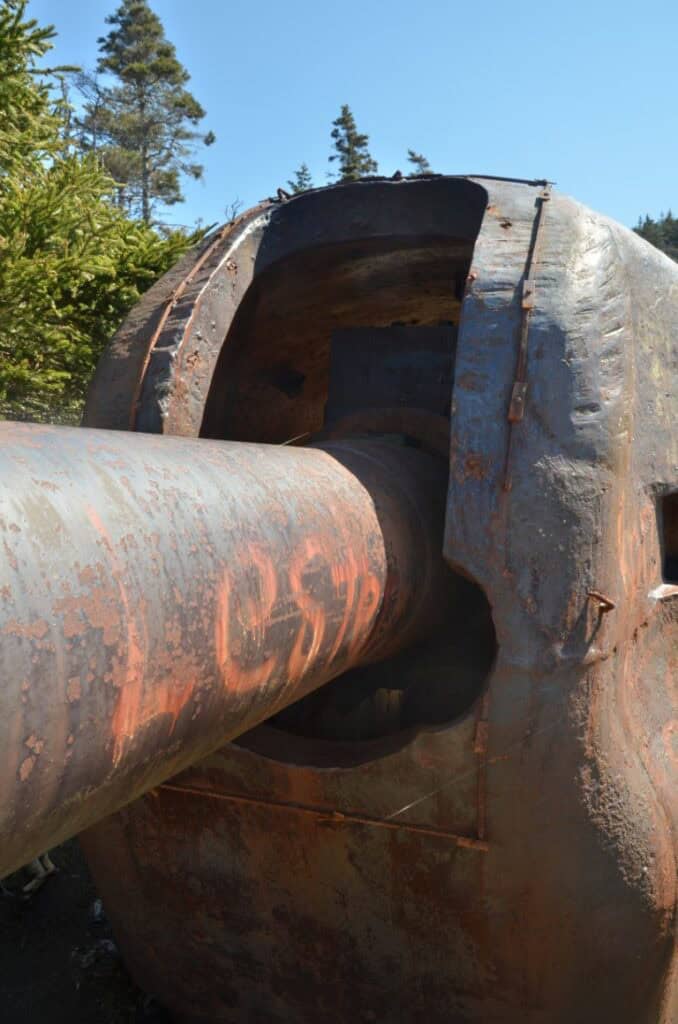
Each battery contained a central underground bunker that was completely self-contained, including its own power plant, sleeping quarters, and ammunition storage. With the primary entrance facing the hillside behind it, each battery also featured two sets of double steel doors on either side leading to large gun emplacements. The guns were M1905A2 rapid-fire guns, measuring approximately 7.6 metres (25 feet) long with a calibre of 6 inches. Mounted on circular concrete pads, each gun was protected by a rusted steel dome known as an M1 Shielded Barbette Carriage (SBC). These guns could fire a 105-pound armour-piercing projectile up to 24 kilometres.


Designed to withstand naval bombardment, it is not surprising that these reinforced concrete bunkers remain standing today. Although showing signs of deterioration, the guns and bunkers serve as lasting reminders of an era when the United States faced the very real fear of attack.
Located just 100 metres from Charter Avenue (Highway 102), Battery 282 is one of the best-preserved American gun emplacements on the island. Designated a Registered Heritage Structure by the Heritage Foundation of Newfoundland and Labrador in 2005, the site still contains its two original guns, which remain pointed out over the water, seemingly continuing to watch over the former base. Historically, access to the underground rooms and passages was possible; however, this is no longer recommended due to poor air quality.
Battery 281 is not designated as a heritage site. Its guns were removed in 1994 and relocated to Fort Columbia in Washington State. While the guns are gone, the circular concrete pads and underground bunker remain. Battery 281 is in a worse state of neglect than Battery 282, suffering from poor drainage that has caused partial flooding and further deterioration of air quality.
Thankfully, neither of the two gun batteries at Argentia was ever used outside of training.


Underground Command Bunker
Near the intersection of Marquis Avenue and Charter Avenue at the former Fort McAndrew site lies one of Argentia’s largest underground complexes. Walking up a short grassy path, two large steel doors quickly come into view. From each door, tunnels extend underground for approximately 10 to 15 metres before connecting to a long perpendicular hallway. On one side of the hallway is a row of utility and operations rooms; on the other, a large room approximately 25 metres by 4 metres extends the full length of the bunker.
Following the hallway to its end leads to a large staircase that continues upward two or three storeys to the top of the hill. The eerie feeling of the underground space quickly fades upon reaching a concrete observation post that offers one of the best panoramic views of the former base.
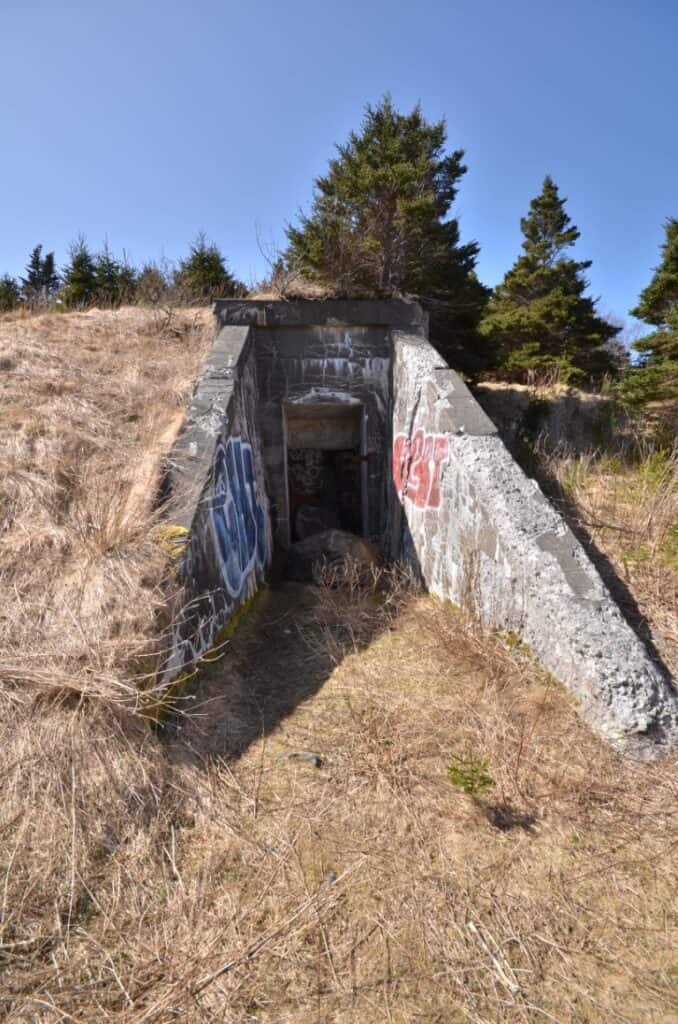
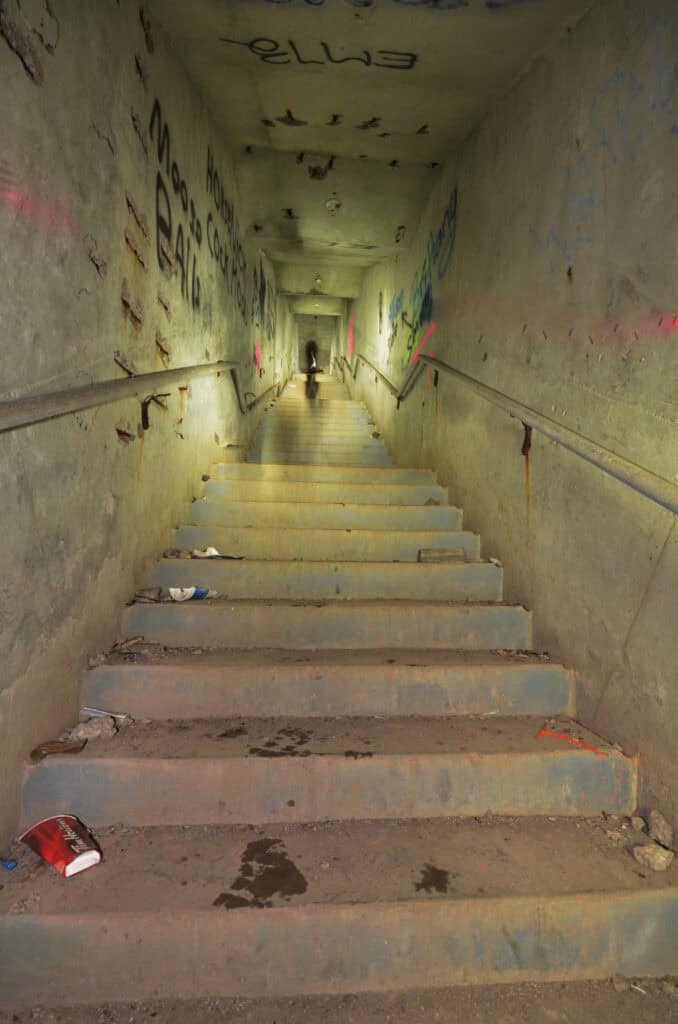

This underground complex is believed to have served as the primary operations and command centre in the event of an attack. Buried deep in the hillside, yet commanding views of Fort McAndrew and the Naval Air Station, it was ideally positioned for protection and oversight. For many years, the bunker was believed to be an underground hospital; while it may have included limited medical facilities, its primary role was likely defence coordination and logistics.
Airfield, Anti-Aircraft Armaments, and Ammunition Bunkers
Before U.S. engineers arrived, the Argentia Peninsula was a grassy wetland with the small settlement of Marquise at its base. When construction of the airfield began in 1940, more than 8.5 million cubic feet of peat, gravel, and earth had to be removed. Facilities constructed included aircraft hangars, a control tower, operations buildings, barracks, and over 750 metres of wharf and warehouses. Covering most of the peninsula were three runways measuring approximately 1,500 metres, 1,700 metres, and 2,100 metres in length. At the end of the longest runway, oriented northeast–southwest, the steel framework of the former landing lights still stands, once used to guide aircraft to safe landings.


Aircraft Hangars
Aircraft hangars, maintenance facilities, and tarmac were built along the south side of the runways, with a control tower at the centre of operations. For many years following decommissioning, the hangars remained abandoned while surrounding buildings were demolished. Two hangars survived until the late 2010s, when they were removed to make room for Husky Energy’s graving dock.


Argentia Harbour
Between the peninsula and the mainland lies Argentia Harbour, a large ice-free port well sheltered from the open waters of Placentia Bay. Along its shoreline, wharves, refuelling stations, and warehouses were constructed. South of the airfield, a seaplane base was also established, remnants of which remain visible today.
Ammunition and Storage “Igloos”
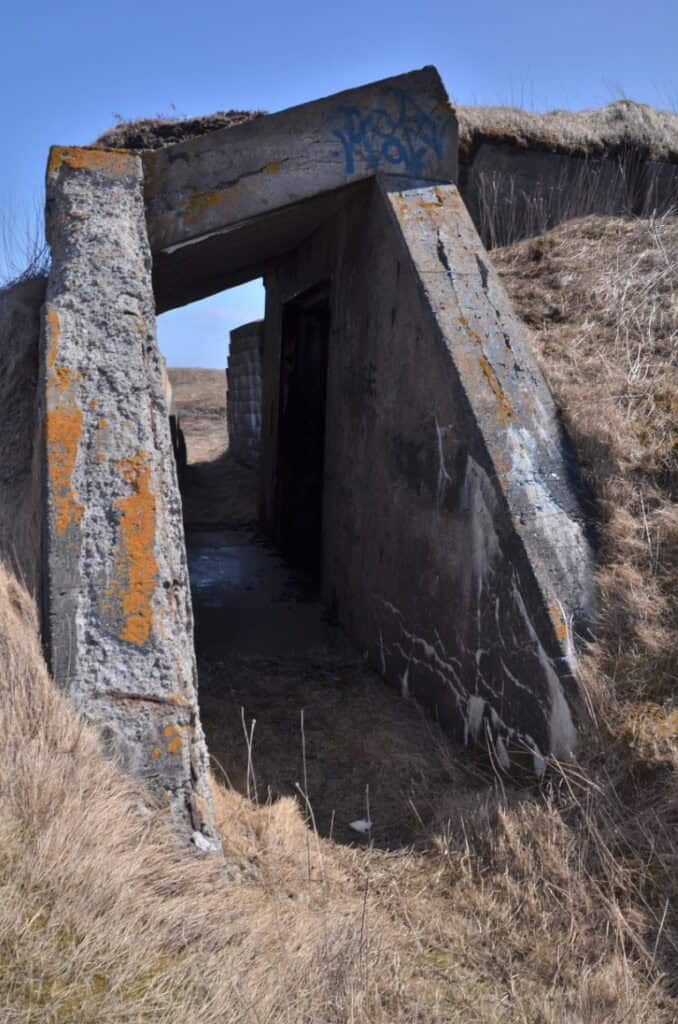
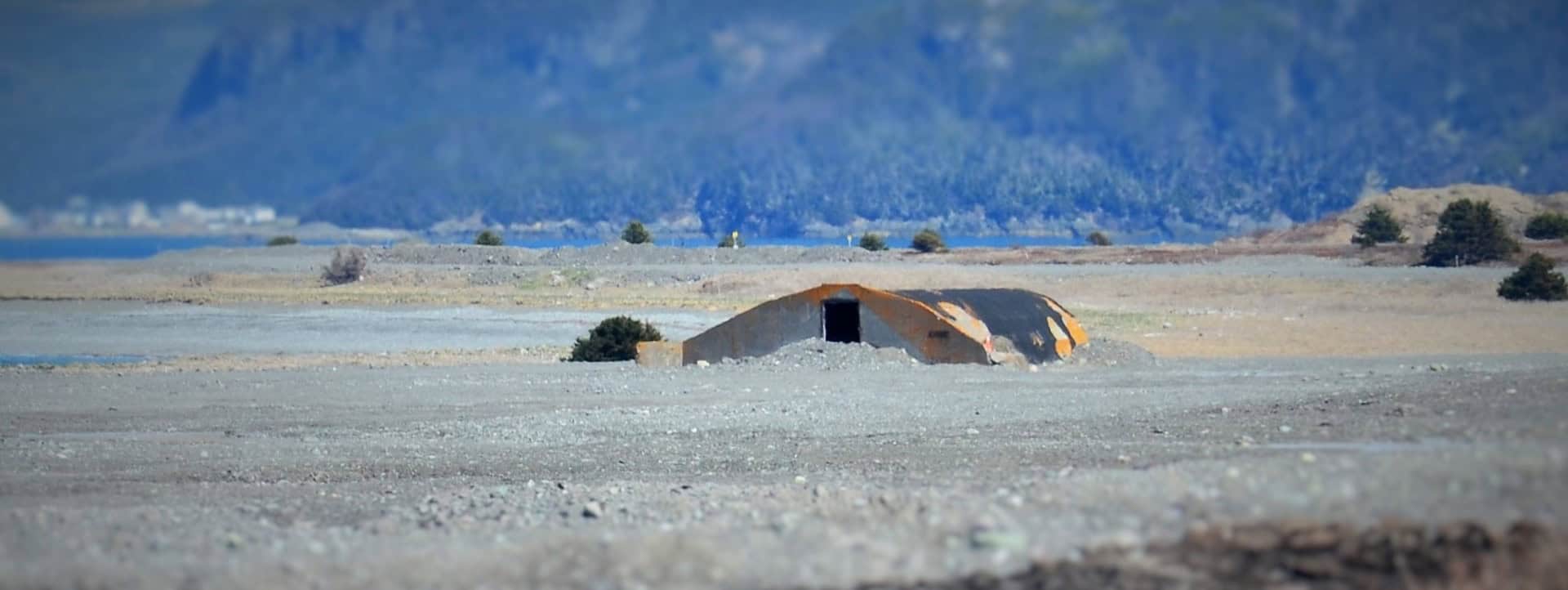
Throughout the airfield and the hills surrounding Fort McAndrew, dozens of reinforced concrete bunkers, commonly referred to as “igloos”, were built to store ammunition and explosives. Each featured large steel doors and was covered with soil and vegetation to camouflage the structure from aerial detection.

Conclusion
Argentia began as a small coastal outport and was transformed almost overnight into one of the largest overseas U.S. naval bases of the Second World War. The cultural, social, and economic impacts on the region were profound. For more than 50 years, the base provided stable, well-paying employment and functioned as a major economic hub. Revitalized during the Cold War, the Argentia Naval Air Station and Fort McAndrew were eventually shut down as the risk of conflict diminished and advances in technology rendered the base obsolete.
For years, much of the base infrastructure was demolished or left abandoned. Over time, the Canadian Coast Guard and Marine Atlantic restored the former wharves for use as a ferry terminal and resupply depot. In the mid-2010s, the region experienced renewed activity with the construction of the West White Rose Concrete Gravity Structure. New industries and commercial enterprises have since returned, taking advantage of the extensive flat and partially paved lands. Today, massive wind turbine components can often be seen staged along the former runways, awaiting shipment and installation around the world.
While Argentia has entered a new era of development, relics of its wartime past endure. The site stands as a powerful reminder of the American military presence in Newfoundland and Labrador. The gun emplacements and underground bunkers scattered throughout the area continue to tell a story of the fear and uncertainty that defined both the Second World War and the Cold War, while also acknowledging the lasting social, cultural, and economic influence the base had on the people of the region. As such, the former U.S. military base at Argentia remains a compelling and often overlooked chapter in Newfoundland’s history.
How to Get There
Argentia is located north of the town of Placentia. The easiest way to reach the site is by following signs for the Marine Atlantic Terminal, located at the end of Route 100, approximately 43 kilometres south of Whitbourne and the Trans-Canada Highway. A network of gravel and paved roads allows visitors to drive through much of the former base.
Sources
282 Coastal Defence Battery Registered Heritage Structure. Canada’s Historic Places website found at www.historicplaces.ca/en/rep-reg/place-lieu.aspx?id=3843.
Geocaching.com. (2012, August 19). Hospital Hill (Traditional Cache) (GC3V35X). Retrieved from https://www.geocaching.com/geocache/GC3V35X.
Ray, W. (2016). US Military Bases in Eastern Canada: Harmon, Pepperrell and Argentia. London, ON: HMS Press.
A map of the 200 series Batteries at Argentia Photo Taken From HistoricPlaces.ca
Find out more about the Argentia Naval Base and more by exploring the Naval History and Heritage Command’s website found at www.history.navy.mil.