Located in north central New Brunswick is the highest mountain in the Maritime Provinces, Mount Carleton, which rises 820 meters above sea level. Of course, it’s location 100 kilometres inland means the topographic relief is slightly less than that but despite this it continues to capture the attention of all those who drive the secluded Highway 180, west of Bathurst. The mountains throughout the area belong to the Appalachian Mountain Range. Far from human settlement, the hills are covered in dense forest made up of balsam firs, spruce and sugar maple trees. Most notable the hill and surrounding areas are prime location for spotting the park’s local residents such as moose, bears, and deer.
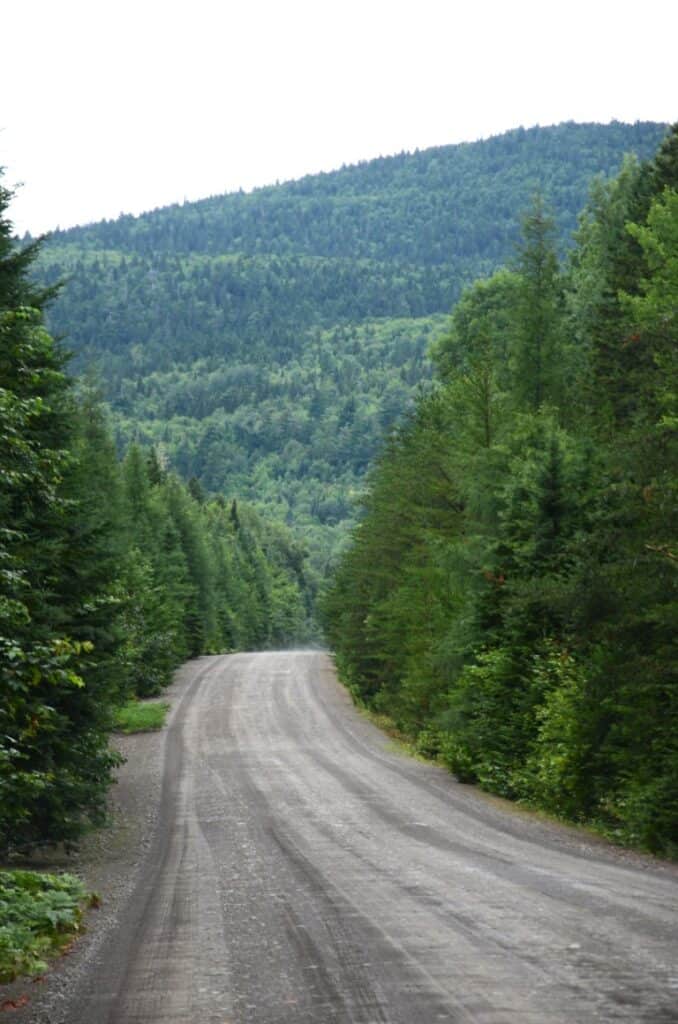


The mountain is joined by neighbouring Mount Bailey and Nictau Lake to form Mount Carleton Provincial Park. The park includes a beautiful wooden lodge on the west side of the lake containing a café, gift shop and information pertaining to the park, its many hiking trails, and offers paddle board and canoe rentals in the summer and cross-country skis, snowshoe, and fat bike rentals in the winter. The lodge also provides the most up to date information on trail conditions as staff monitor and report on any washouts, repairs, wildlife sightings, and monitoring overnight hikers within the park. This is important to note as there is no cell service anywhere in the park so online resources should be downloaded using wi-fi at the lodge before heading on any adventures. A gravel road circles the lake connecting several campgrounds, day use areas, and hikes along the way. The area is a true hidden gem, offering some of the best hiking in the Maritime Provinces.
Mount Carleton itself is made up of three peaks. The highest is Mount Carleton in the south while Mount Head overlooks the eastern flank, and Mount Sagamook at it’s north face overlooking Nictau Lake. As with the rest of the Appalachian Mountain Range which runs from Alabama to Newfoundland. The landscape we see today is a product of a long geologic story. What we se e today was formed during the last ice age when ice sheets scrapped across the continent. Mount Carleton got its shape during this time when hard volcanic rock resisted the moving ice sheet, leaving behind an isolated peak rising above the surrounding landscape. This type of feature is known as a monadnock.

Atop the mountain, a lonely wooden cabin rest on it’s summit, anchored to the surrounding rock by an array of steel wires. The views form the summit are unparallel to any other in the province. The area’s designation as a provincial park has protected the area’s dense Acadian Forests, a unique trait in a province heavily reliant on logging. Intermixed with lakes and rivers, stands of balsam fir, black and red spruce, white birch, and sugar maple, the area has become home to moose, black bear, deer, and countless species of birds.
Our Trip & Advice
We visited Mount Carleton in early August. While we lucked out in sunny, hot days, the high elevation meant that both nights we were clouded in fog with temperatures plunging to the single digits. Armstrong Campground on the north side of Nictau Lake was our basecamp for the next few days where we were greeted by spectacular views of the mountain located on the lakes opposite side.
The morning after we arrived, we got coffee and breakfast at the Mount Carleton Lodge, parked our car at the Mount Sagamook trailhead and began our ascent. There are two trail options when hiking Mount Sagamook; a steep, more direct ascent or a longer, gentler route. We chose the steeper route and while Koda, our husky, struggled a little traversing the steep, boulder field near its peak, we were happy to have chosen the route both from a time perspective, but also because of the many beautiful vantage points you get to see along the way.


The trail from the 782-meter peak of Mount Sagamook on the north side of the mountain to the 820-meter peak of Mount Carleton at its south end, was relatively flat and protected as you walked through dense forest. While this route was flat and relatively easy hiking, it also meant that you were constantly fleeing swarms of flies. Although it was prime hiking season, we only encountered a few groups at the first peak and then even less on the rest of the route. The trip all became worth it however as you start to climb the barren base of Mount Carleton and begin the last 70-meter ascent to its peak.
The wooden cabin at the top is open for public use and features a table and bench, but not much else besides the heavily graffitied walls that seem to be used as a guestbook. Despite its sparse interior, it makes for a great stop to take a break and escape the constant wind. It might be helpful to also note that there are no pit toilets or garbage cans at the summit, so as usual if you’re hiking- you pack it in, you pack it out. After taking in the views and a quick celebratory beer from Bathurst’s 13 Barrels Brewery, we made our way back the same path that brought us here. The sun was starting to get low on the horizon by the time we caught site of Mount Sagamook’s peak. Despite this we made the quick detour to the Mount Head look off on the mountains east flank. A few pictures later and we found ourselves back at the top of Mount Sagamook, descending 500 meters into the now dark valley below us. Tired, hungry, and in complete darkness we arrived back at our vehicle 9 hours after we left it.


After a warm hearty supper and then some much-needed rest, we spent the following day exploring the beaches, day parks, and waterfalls found within the park. Amongst these was Williams Falls, a small but beautiful falls found within a vibrant green forest.
For this kind of hike, we highly recommend packing lots of water and snacks, especially if you have a furry friend along with you as there are little to no natural water sources along the top to draw from. We also recommend sunscreen and bug spray, as well as pants and a long sleeve shirt as the trail is quite narrow between the peaks. There is some rock scrambling involved both on the Mount Sagamook trail but also to the summit of Mount Carlton where sturdy hiking boots came in handy.

Conclusion
Mount Carleton Provincial Park is perfectly located at the center of New Brunswick. In a province which has been logged for centuries it provides a refuge from the human-influenced forest that the interior of the province is often associated with. It’s isolated and remote location makes it the perfect escape from urban noise, allowing one to fully engulf themselves in some of the best scenery the Maritime Provinces has to offer. This glacially sculpted landscape hides an untold number of secrets and hidden gems, and Mount Carleton Provincial Park remains the perfect place to begin exploring.