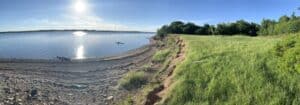
For 90 years the Newfoundland Railway was a vital way of transporting people and services across the island of Newfoundland. The railway began with a main railway line between between the province’s capital of St. Johns and the ferry terminal in Port Aux Basque. Overtime, branch lines were constructed to connect Newfoundland’s many coastal communities with the main line itself. In November 1911, the railway’s operators, the Reid Newfoundland Company began construction on a branch line between Clarenville and the town of Bonavista. For most of it’s length, the route selected incurred few challenges engineers thanks to to the relatively low elevation changes of the interior of the Bonavista Peninsula.

One problem arose however when they attempted to bring the train into the town of Trinity. The town is located along the coast and is surrounded by steep hills which would have made it impossible to get to by train. The solution was a two kilometer extension that would loop around a nearby pond (later named “Loop Pond”) and gradually lower the railway tracks to an acceptable elevation. To do this the Reid Company hired the engineer J.P. Powell to design what would become known as The Trinity Loop.
Powell designed a system where the incoming tracks in the northwest would cross over a valley, circle around the outside of the Loop Pond, approximately 2,000 meters in length, and then pass under itself while leaving the valley. While not unusual in Western Canada, the loop was notably unique for the small island of Newfoundland. Construction began in 1910 and was finished the following year.

“Finish the Drive in ’65” was the slogan Joey Smallwood used to describe the goal of completing the Trans-Canada Highway from St. John’s to Port aux Basques. This was a major milestone in the province’s history, not only because it provided an accessible means of transportation, but also because it marked the beginning of the decline of the Newfoundland Railway.
Soon, buses began replacing passenger cars, eventually leading to the end of passenger service on July 2, 1969. After this, sections of the railway remained in use for freight, but these too were slowly phased out through the 1970s. In 1984, Terra Transport, the last operator of the line, ended service, marking the end of the Bonavista Branch Line and the need for the Trinity Loop.


But shortly after hearing the news former railwayman, Clayton Cook began organizing campaigns and petitions to preserve the loop. With the help of several politicians, Terra Transport eventually transferred the loop over to the town of Trinity. It was too long after this that Francis Kelly purchased the land and turned the area into an amusement park which included boat rides, accommodations, amusement rides, a museum, and even a train ride around the loop. In February 1988, the Trinity Loop was registered as a heritage structure helping to preserve its history and structure from drastic change.

Gander Beacon. (1985, July 31). Gander Beacon [Digitized newspaper issue]. Memorial University of Newfoundland Libraries, Queen Elizabeth II Library. https://dai.mun.ca/PDFs/ganderbeacon/GanderBeacon19850731.pdf
The park operated successfully for a number of years but as time went on, peoples interest in the park slowly declined and in 2004 the park was shut down. But even today there are still many people who want the loop to remain preserved and there are many who wish to see it saved from destruction.


About the Area
In September 2010 Hurricane Igor blew through the province earning it the title as the most destructive tropical cyclone to the hit the island. The storm was devastating for the Trinity Loop. Extensive rainfall caused the river flowing through the park to wash away nearly 100 feet of tracks and deposit rocks and sediment over any remaining features of the amusement park.

Not everyone has given up on the park. After the previous owner defaulted on payments shortly after the park’s closure the land was transferred over to the provincial government and has since been considered crown land. Several people over the years have attempted at reopening the park but none have been successful. Although there is a huge number of people on the island who would love to see the train carrying people around the pond again and the amusement park running, there are some who believe the loop has seen its last day.
Sources & Further Exploring
Clarkson, M. (n.d.). Province doesn’t want The Loop. The Telegram.
Heritage Newfoundland and Labrador (2011, January). Trinity Train Loop (Trinity). Newfoundland and Labrador Heritage Web Site. Found at https://www.heritage.nf.ca/articles/society/trinity-train-loop.php.
Parks Canada (n.d.). Trinity Train Loop. Canada’s Historic Places Website. Found at https://www.historicplaces.ca/en/rep-reg/place-lieu.aspx?id=2175.
Smallwood, J. R., & Pitt, R. D. W. (1981). Encyclopedia of Newfoundland and Labrador. St. John’s, N.L.: Newfoundland Book Publishers. (Article: “Loop, The”. Available online through the Centre for Newfoundland Studies collections database)