A Journey Along Ireland’s West Coast
Passing through the hub town of Tralee, we drove the N69 to Listowel, where we made a quick stop to see the historic town centre. Most notably, we wanted to see Listowel Castle, a fifteenth-century fortification built by the Fitzmaurice family. Entering the castle-turned-museum, we spoke with a tour guide who shared the history and stories contained within the castle’s walls. The tower, originally four-sided, was used as an early fortification and defence structure for families and farmers living in the area. In October 1568, the tower came under siege by Sir Charles Wilmot, who was seeking to destroy resistance against English rule in the country. The castle fell 28 days later, with Wilmot ordering the execution of all inside.


If visiting the area, take a tour of the castle, because we learned more in our 30-minute conversation with the tour guide there than we ever expected. We were told stories of how the castle was used as a seat of prominence for the family, the challenging conditions soldiers lived in while stationed there, and the cultural and historical setting that led to the tower’s siege. This then led to another eye-opening fact: the stone structure, which is now comprised of two towers joined by an arched wall, originally had four towers. He went on to explain that during the years of the Irish Famine in the mid-nineteenth century, energy had to be conserved and, as a result, when new buildings were constructed—such as the Gothic church across the street in Georgian Square—locals dismantled the castle’s tower walls to reuse the stone and save a long and energy-consuming journey to distant quarries.
Our conversation eventually turned to Irish culture today and the efforts being made to protect and conserve it. Even though we always knew it to be true, it was eye-opening to hear the candid thoughts on the appropriation of Irish culture in caricatures—such as leprechauns and Lucky Charms cereal. Coming from North America, a place long seen as a refuge for Irish immigrants, it was moving to hear the sorrow of a local Irishman as he shared how the culture gets lost as people leave and becomes reduced to cartoonish stereotypes of what is such a historic, friendly, and enduring people. Of course, this is not always the case, but the more we reflected on these sentiments, the more we came to appreciate and respect how we have identified and portrayed Irish culture, having grown up in a place like Newfoundland, Canada.
We could have stayed there all afternoon, but with a plane to catch we gave many thanks before heading out to Georgian Square, taking a different perspective on the cut stone that made up the church across the road, and continued on our journey to Tarbert.
Crossing the River Shannon
The River Shannon is Ireland’s largest river, and the estuary it forms as it enters the Atlantic Ocean was our next destination. Our plan was to cross the river at Tarbert Island and land on the north side. This plan was put in jeopardy as we made the mistake of checking the ferry schedule just as we entered the town of Tarbert. With the schedule saying the next ferry would depart in five minutes, we flew through the community as fast as we safely could and wound around the coastal road, driving onto the ferry just as its ramp was lifted.


The river has long been home to industry such as the coal-fired Moneypoint Power Plant and oil-fired Tarbert Power Station, from where the ferry departed. Despite the industrial backdrop, the estuary is a sanctuary for wildlife and marine life. As we departed, we quickly spoke to one of the ferry’s workers, who said we had a high chance of seeing porpoises that regularly enter the river. Sadly, we never did see them, but this did not take anything away from the beauty of the river and surrounding heritage structures such as the historic Tarbert Lighthouse.

Twenty minutes after we departed, we landed on the opposite side. Originally, we had planned to drive northwest towards the Cliffs of Moher, but given that it was getting late in the day, we took a shorter route—grabbing lunch in the town centre of Ennis—and continued north on the M18.
Kilconnell Franciscan Friary
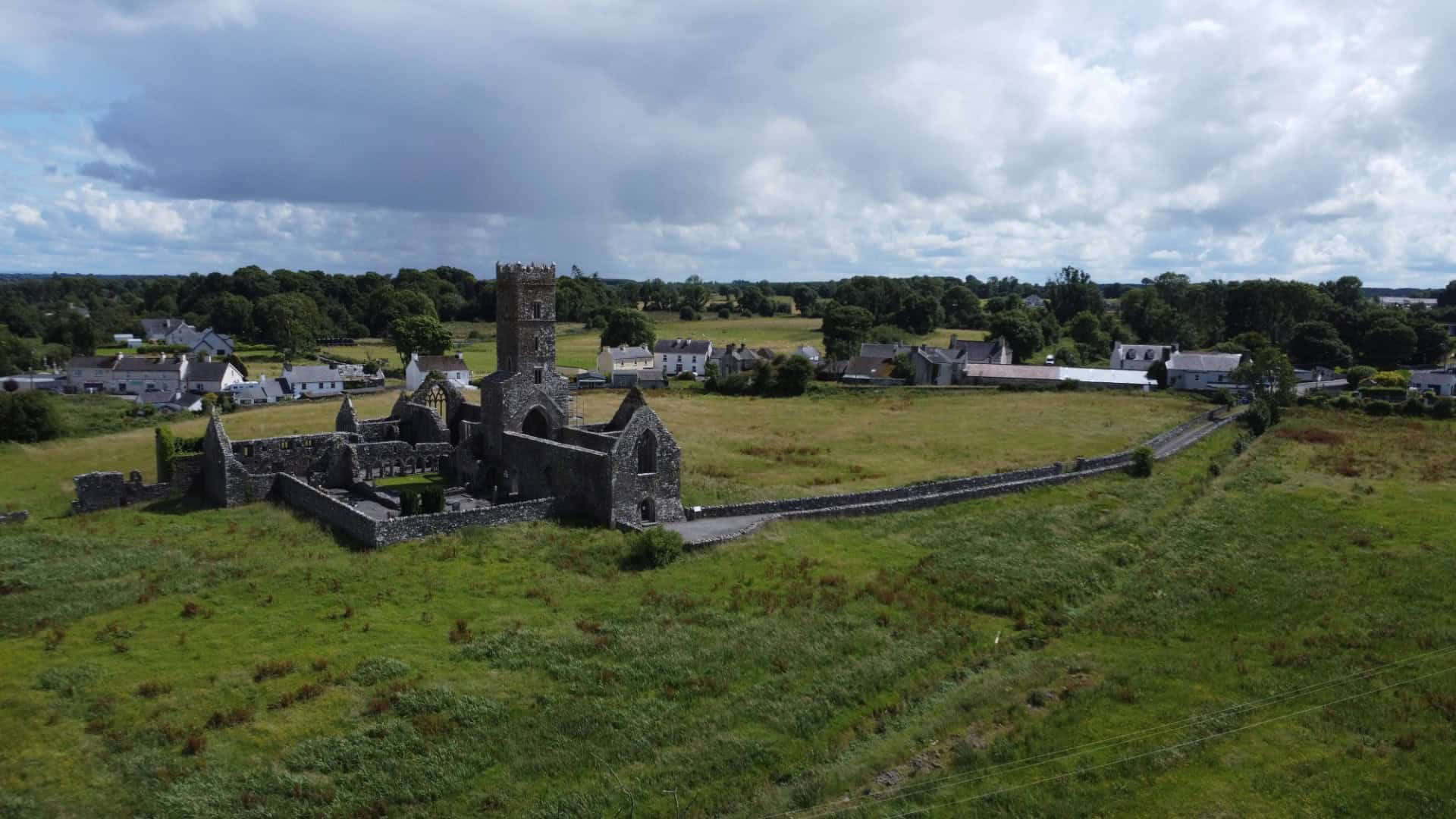
We decided to see the countryside one last time before continuing on our journey and chose to visit the ruins of the Kilconnell Franciscan Friary in the farming village of Kilconnell. To get there we followed a mix of highways and country roads, winding through farmland and forest, where tall trees created tunnels for the road to pass through. Eventually, we caught sight of the ruins, now surrounded by farmland. With no clear way to hike to them without walking through tall grass, we decided to view them from afar and get a closer look using our drone.

The ruins formed a complex of rooms separated by thick stone walls. Built sometime between 1353—when the friary was founded by William Buí O’Kelly, lord of Uí Mhaine—and 1414, the friary was a monastery for members of a mendicant religious order within the Roman Catholic Church known as the Franciscans. This order was founded on the principles of poverty, humility, and direct service to the poor.


The structure was continually used until at least the 1700s, playing a critical role in the area’s cultural and religious history, and even acting as a garrison during times of conflict. By the late nineteenth century, the structure was abandoned but remained in good shape. During our visit we noticed renovation work happening within the structure, suggesting it is being restored for a new purpose. After surviving for more than 650 years, it seems the ruins of Kilconnell Franciscan Friary will continue to be an important historic landmark in the region.

With the afternoon getting late, we made our way to our last stop in Ireland before heading to Dublin International Airport.
Athlone
Between Galway and Dublin lies the historic and cultural centre of Athlone. Known for its vibrant culture and architecture, including its many churches and Athlone Castle, our primary reason for stopping here was to grab a beer in Sean’s Bar—a small pub that has been serving beer since 900 AD, making it Ireland’s oldest pub. The cozy, dark pub did not disappoint. Packed full, we overheard conversations of people talking about their travels and where they had come from. It seemed the bar had become a tourism hotspot, but one that fostered fun conversations about adventure and future destinations. After finishing our beer, we took in the sights of the enigmatic Athlone Castle shadowing over the upper, yet still navigable, reaches of the River Shannon. Leaving here, we made our way to Dublin International Airport, sticking to the main motorway all the way there. That night we flew to London—perhaps as far removed from the Irish countryside as one can get.


Conclusion
While our time in Ireland was too short, it rekindled a deep sense of adventure and love for travel. Growing up in a place like Newfoundland—with deep Irish roots and a geography so similar to Ireland—we had never placed the country high on our bucket list. Yet visiting the land, experiencing the culture, and meeting its kind-hearted people not only reignited our passion for exploration but also deepened our understanding of the place we call home. From the accent to the colloquialisms, it seemed that at every turn we encountered a piece of tradition or an old saying we had not heard since leaving Newfoundland. But the Ireland we thought we knew was merely the tip of the iceberg compared to the vast and layered history of its people and place.

And this is to say nothing of the country itself, where around every corner a new landscape awaited. From the fabled Rock of Cashel to the windswept coastline surrounding Hook Lighthouse, from the rugged beauty of the Copper Coast to the timeless charm of the Dingle Peninsula—the landscape proved as enduring and resilient as its people.
Having spent a lifetime seeking out lost ruins and sharing the stories of forgotten historic structures, we could easily have spent an eternity exploring Ireland’s countless abbeys, castles, and fortified remnants. Each historic site told a new chapter in the story of Ireland—an enduring reflection of the hardships and triumphs its people have faced.
Ireland is truly a land of endless wonder and stories. Our bucket list grew far longer as we departed than when we first arrived—and that is exactly how a place should be.