Waking up in Árnes, we were only slightly disturbed by the thin layer of ice that had accumulated on the tent overnight. After letting the tents dry for a few minutes, we packed up our gear and continued south to the town of Hella, where our expedition around Iceland’s famous Ring Road officially began.
American School Bus Cafe
Caffeine-deprived, our first stop of the day was the American School Bus Café. This roadside café, housed in a bright yellow school bus, began its life in Pennsylvania before finding a second career with a church group. A tribute to this period can still be found outside the bus, where one of the only direct phone lines to God is mounted. Sadly, she must have been busy on the day of our visit, as no one picked up for us.


Eventually, the bus was purchased by a Romanian businessman, shipped to Romania, and left unused for several years. The current owner, himself of Romanian descent, later bought the bus and shipped it to Iceland. After extensive restoration, it was transformed into a café that instantly captures the attention of anyone driving by. Today, in addition to “calling the almighty” if you wish, you can enjoy a delicious coffee and baked goods inside one of the country’s most unique cafés.
Ægissíðufoss Waterfall
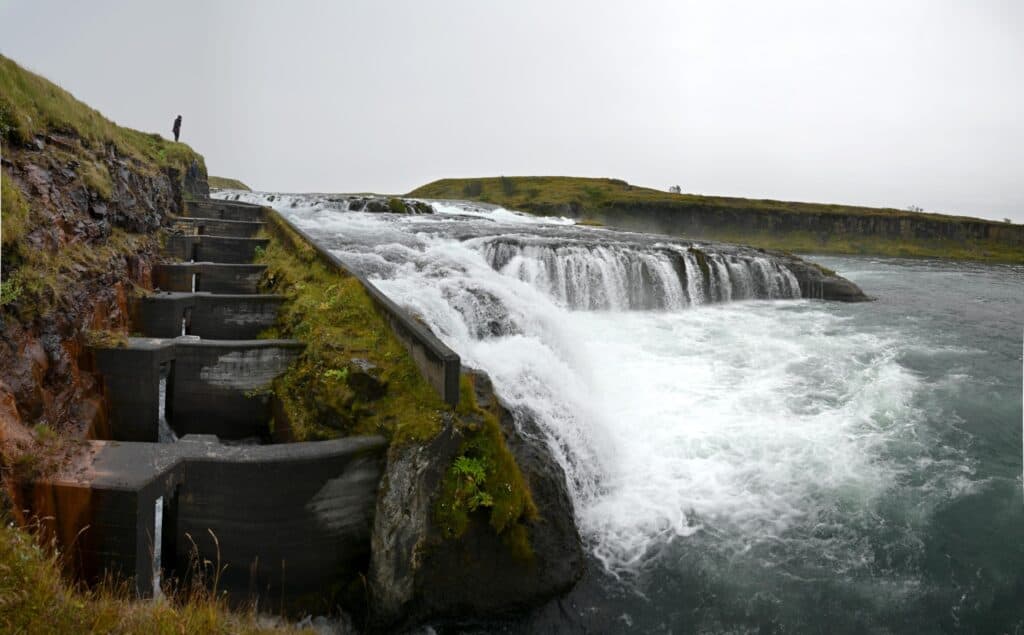
From here, we began what would turn into a day of chasing waterfalls. Located on the Ytri-Rangá River, just south of Hella, is Ægissíðufoss. While not the tallest waterfall, it makes up for its modest height with impressive width, stretching more than 50 meters across the river. Surrounded by lush farmland and draped in the morning’s fog and drizzle, the falls were a beautiful way to begin the day.
After climbing down the steep riverbank, we took a few photos of the falls and its adjacent salmon ladder before heading back to the car and continuing to the next stop.
Gluggafoss (also known as Merkjárfoss)
Gluggafoss, also called Merkjárfoss, requires a short detour off the Ring Road onto Highway 261. With a total drop of 52 meters, it is actually composed of two separate cascades. The name Gluggafoss derives from the Icelandic word gluggar, meaning “windows,” a reference to the several openings that the water crashes through as it descends the moss-covered hillside. Over thousands of years, the rushing water has carved tunnels and “windows” into the cliff, giving the falls its distinctive name and enchanting character.
The falls sit near the base of several volcanic systems, one of which is the stratovolcano Hekla. In 1947, an eruption covered the river and falls in thick ash, temporarily stopping its flow. Over the following years, the water gradually carved its way back out, a striking reminder of Iceland’s ever-changing landscapes. Closer still looms Eyjafjallajökull, the glacier-capped volcano made infamous by its 2010 eruption that disrupted air travel across the Atlantic for months. Despite repeated attempts, we still couldn’t manage to pronounce its name correctly.


Gluggafoss turned out to be a hidden gem we more or less stumbled upon. Just far enough off the main road to avoid large crowds, we had the place almost entirely to ourselves. A picturesque bridge at its base and the two-tiered falls framed by green hillsides made it a perfect spot for photos, further enhanced by several smaller cascades nearby.
Seljalandsfoss and Gljúfrabúi
From here we continued to Seljalandsfoss and Gljúfrabúi. While both were stunning to explore, the enormous crowds left no doubt as to why they are considered two of Iceland’s most visited waterfalls. Originating from glaciers high on Eyjafjallajökull, Seljalandsfoss plunges 60 meters from the Seljalandsá River into the valley below. What makes it unique is the path that leads behind the falls, offering a perspective unlike any other in Iceland. Of course, as every travel vlog will tell you, the hike will leave you soaked, so waterproof gear is highly recommended—unless you prefer to admire it from the front.
Nearby, Gljúfrabúi hides a surprise of its own. After cascading down the cliff, the waterfall continues into a narrow gorge, crashing into the cave floor below. A small opening at the base allows visitors to step inside and look upward at the falls from within. Unsurprisingly, this dramatic setting draws long queues of visitors; on our visit, at least seventy people were lined up to enter, and we opted to skip the wait.


Between the cliff faces, patches of vivid green grass provided grazing for local sheep, and we snapped photos all the way back past the gift shop, hot dog stand, free washrooms, and finally to the parking lot.
Skógafoss
While Seljalandsfoss may be one of Iceland’s most popular waterfalls, it still cannot surpass the reputation and fame of Skógafoss. The falls are best described as a curtain of white water draped over a 60-meter cliff, blanketed in bright green grass and moss. No doubt, Skógafoss attracts hundreds of visitors each day, but this does nothing to diminish its majesty.

We recommend visiting early in the morning to beat the crowds, as it was nearly impossible to capture a photo of the falls without dozens of people at its base. Following the river downstream, however, revealed quieter vantage points and new perspectives away from the bustle. For those who enjoy a climb, a staircase on the east side of the falls leads to the top, where a lookout offers views over the rim and two smaller waterfalls, Hestavaðsfoss and Fosstorfufoss.
Lindsay and I were too captivated by the view at the base to make the climb, spending our time trying to capture even a fraction of the falls’ beauty on camera, while Nick and Colleen enjoyed the quieter hike to the top.


Mia’s Country Van
By this point, we were more than ready for something other than trail mix and granola bars. Before leaving the area, we stopped at a small food truck called Mia’s Country Van, specializing in fish and chips. What followed may have been the best fish and chips we had ever eaten—high praise coming from two Newfoundlanders. Recharged, we continued driving east, trading waterfalls and volcanoes for glaciers.
Sólheimajökull
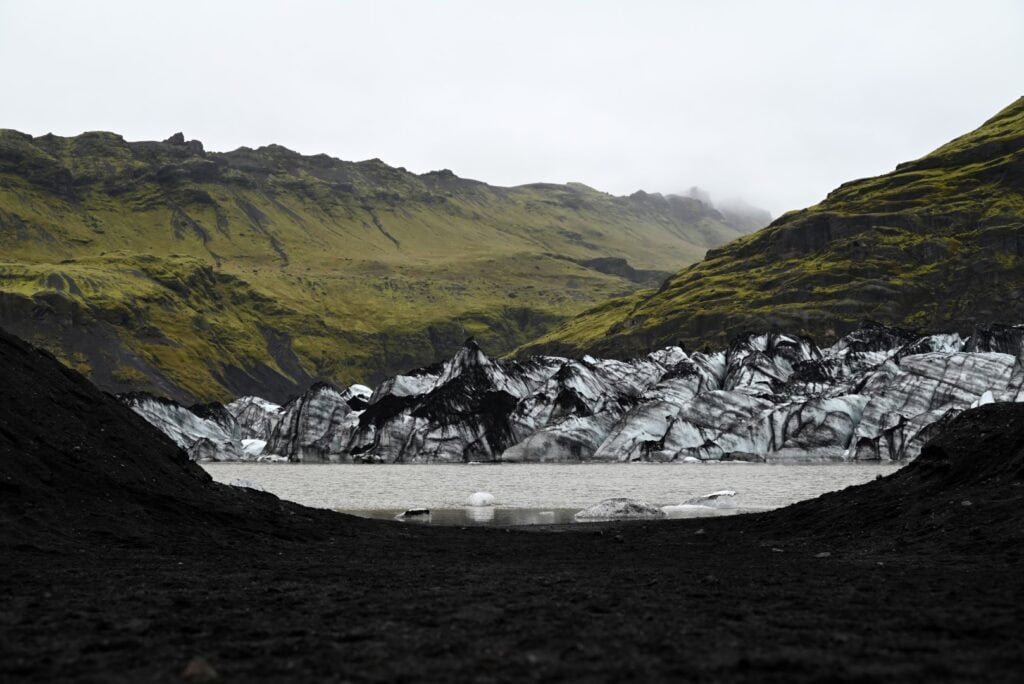
Just a short detour from the Ring Road brought us to Sólheimajökull, a glacier tongue extending from Mýrdalsjökull, Iceland’s fourth-largest ice cap. Nestled in a steep glacial valley surrounded by dark volcanic rock, the glacier forms part of the Katla volcanic system—one of the country’s most dangerous and closely monitored volcanoes.
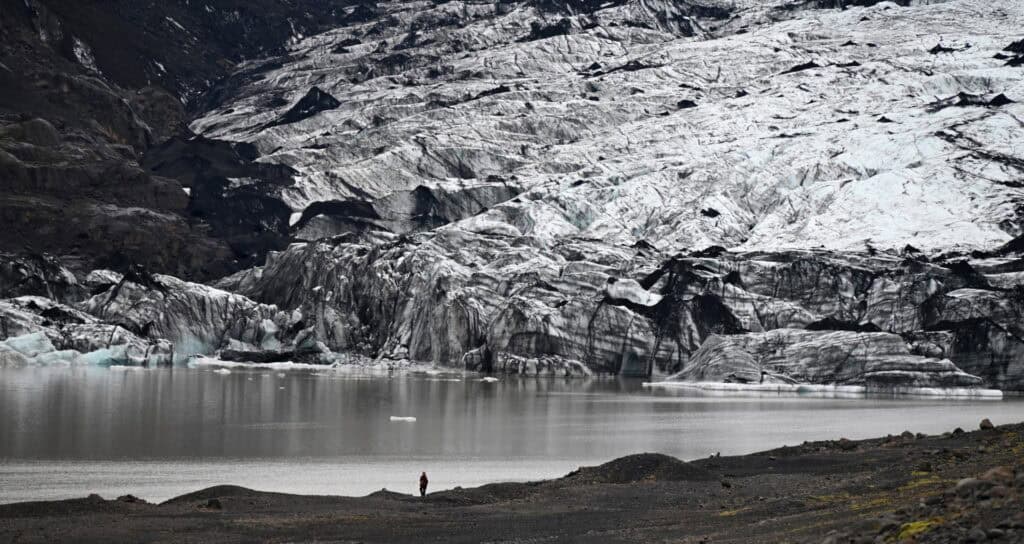
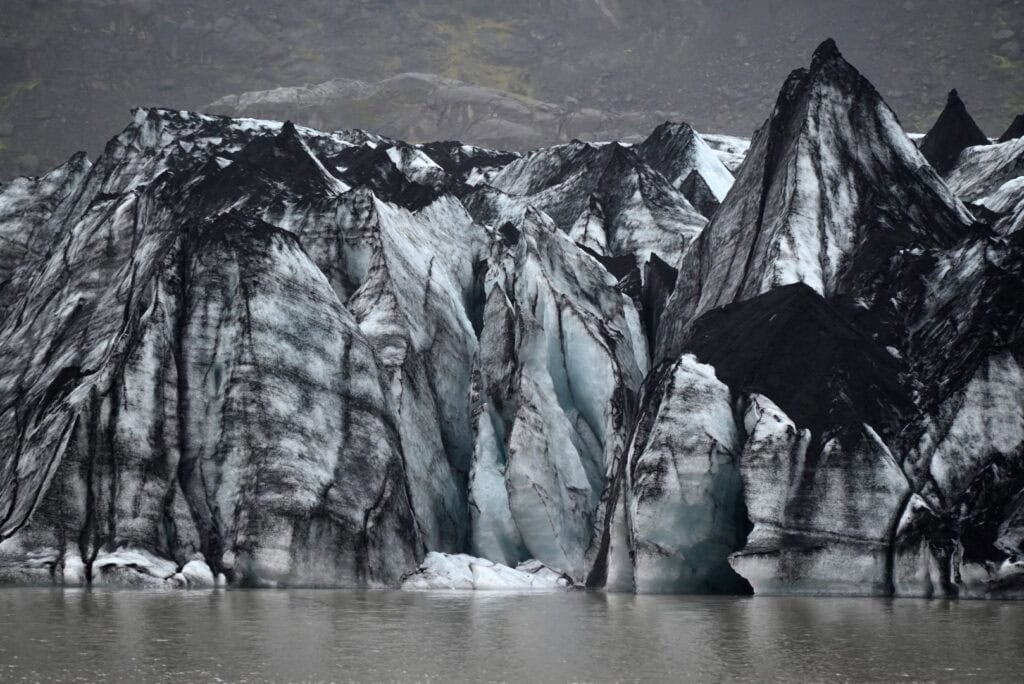
Sólheimajökull terminates in a small lagoon often scattered with icebergs that have calved from the glacier as it creeps down the valley. Each chunk of ice, like the glacier itself, displays striking colors, from deep blue to brilliant white, streaked with dark volcanic rock and glacial till scraped from the surrounding hillsides.
Parking here was free, and while tours are available to hike the glacier or kayak the icy lagoon, the walking trail to the glacier was open to all. Along the path, interpretive signs explained the ongoing Climate Change Monitoring Project, which documents the glacier’s retreat and the impacts of human-driven climate change. Markers indicated the glacier’s former positions, each one further up the valley than the last. Today, the glacier loses more ice each year than it gains, a trend that will ultimately see it vanish. The speed of its decline was sobering, and I do not think it is an exaggeration to say: visit these natural wonders while you can, because they will not always be here.

Vik Camping
As evening approached, we left Sólheimajökull and drove toward the town of Vík. Concern arose when we received a wind and rain warning for the night—ordinarily no issue, except we had already booked a campsite there.
Vík sits sheltered behind low dunes and a black sand beach, nestled between a rocky headland and the steep mountains marking the start of the Katla volcanic system. Famous for its picturesque church, dramatic sea stacks, and its proximity to Katla itself, the town is also the turnaround point for many visitors traveling the Ring Road from Reykjavík.
Hungry after a long day, we headed straight for Black Crust Pizzeria. True to its name, the restaurant serves oven-baked pizzas with a signature volcanic black crust topped with Icelandic mozzarella. While the crust was more striking in appearance than in flavor, the pizzas were excellent, with plenty of topping options. The restaurant was busy—as it seems to be on everyone’s list—but the staff kept things moving smoothly, and soon we were well fed and ready to settle in for the night.


Vík Camping, located conveniently in the center of town, offered an indoor cooking and dining lodge, paid showers, laundry, and Wi-Fi. It was bustling with campers cooking, cleaning, and socializing. Unfortunately, the only protection from the Atlantic winds was an artificial berm separating the campsites. By the time we arrived, all the sheltered spots on the leeward side were taken. As one of only two groups camping in tents, we had no choice but to set up on the exposed windward side, using our rental car as a makeshift windbreak.
Stepping out of the car, we were met with fierce winds and sideways rain—conditions that did nothing to ease homesickness but certainly tested our resolve. With all hands needed to pitch and secure the tents, we finally got everything in place, cracked open a beer, took quick showers, and retreated to our surprisingly warm tents for the night.